This material may not be published, broadcast, rewritten, or redistributed. ©2025 FOX News Network, LLC. All rights reserved. Quotes displayed in real-time or delayed by at least 15 minutes. Market data provided by Factset. Powered and implemented by FactSet Digital Solutions. Legal Statement. Mutual Fund and ETF data provided by Refinitiv Lipper.
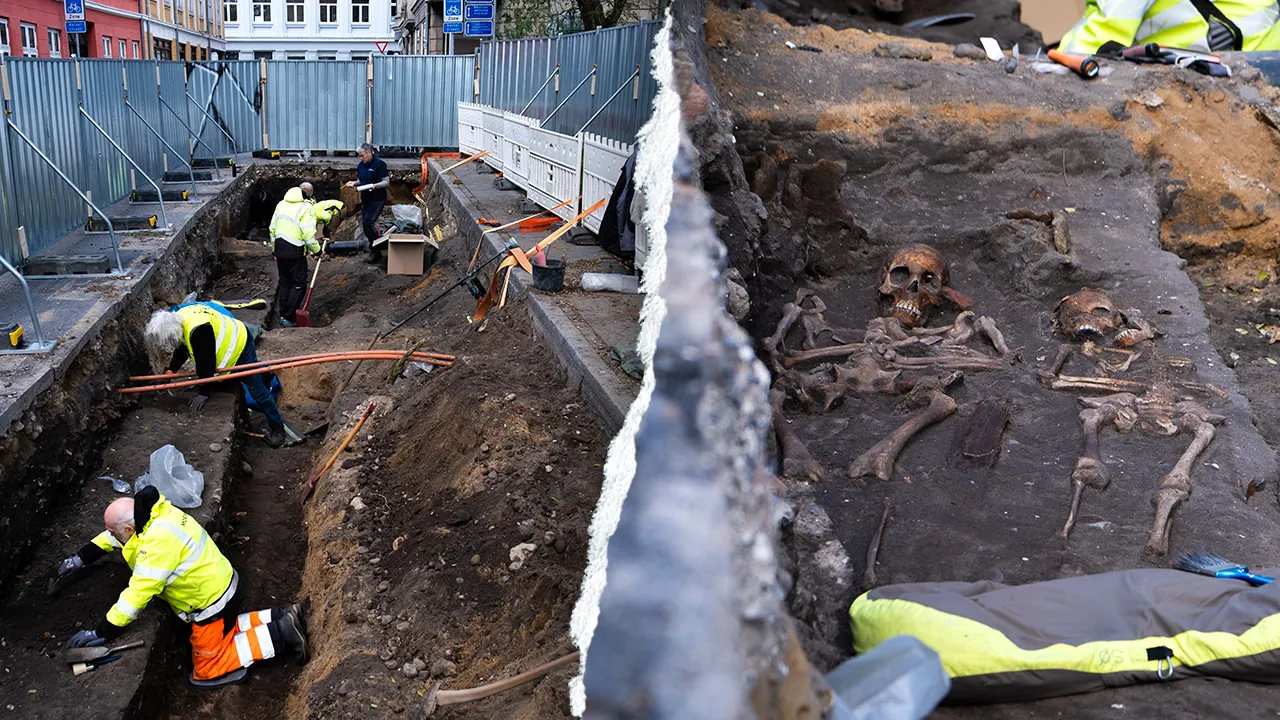
Archaeologists in Brussels, Belgium, recently came across the remnants of an old cemetery located in a busy part of the city. The remains date back to the Middle Ages. (Source: @mijnmivb via Facebook)
Danish archaeologists recently unearthed dozens of medieval graves, shedding light on how disease and hardship shaped life in early Christian Denmark.
Officials from the Moesgaard Museum in Beder, Denmark, announced the discovery in a recent news release.
The skeletons were found in nearby Aarhus, in St. Oluf’s Cemetery, which existed from the 1100s until 1813. It was named after St. Olaf, a Norwegian Viking king renowned for spreading Christianity across Scandinavia.
ANCIENT CHRISTIAN FIGURINES DISCOVERED IN 1,500-YEAR-OLD DESERT GRAVES
“The remains are believed to be up to 900 years old, belonging to a churchyard from the 12th century, near the old Viking town of Aros,” the museum said in a statement. The discoveries came during a city project to upgrade waste facilities.
Mads Ravn, head of the Moesgaard Museum’s local heritage department, told Fox News Digital his team uncovered a remarkable 77 ancient graves in total.
An excavation in Aarhus uncovered dozens of medieval Christian graves at St. Oluf’s Cemetery near the old Viking town. (Moesgaard Museum)
“[It was] much more than expected and very dense,” he said.
The graves didn’t belong to Denmark’s earliest Christian converts, Ravn noted. The religion first spread in the 9th and 10th centuries. Around 965, Harald Bluetooth completed Denmark’s conversion to Christianity, as commemorated on the Jelling rune stone.
The faith appears to have become firmly established in Aarhus by the 12th century; the cemetery represents graves that were firmly rooted in Christianity, rather than transitioning to it.
CLICK HERE TO SIGN UP FOR OUR LIFESTYLE NEWSLETTER
“The town of Aarhus, where the cemetery is found, is important because during its time of use it became the graveyard of the poor, while the rich were buried in the cathedral about 500 meters [1,640 feet] to the south,” Ravn said.
“Therefore, it was densely packed with skeletons, with new burials sometimes disturbing older graves and leaving some of the skeletons in parts.”
Researchers from Moesgaard Museum examined skeletal remains from a Christian cemetery used between the 1100s and 1813. (Moesgaard Museum)
Few of the remains were buried with grave goods, but Ravn noted that one early modern grave featured a curious artifact.
“One from 1626 was buried with a coin in the mouth, suggesting that local folklore, and especially a tradition among sailors, seems to have prevailed,” the archaeologist observed.
CLICK HERE FOR MORE LIFESTYLE STORIES
“It could indicate that the person was ‘secured’ a payment to the other side, [a custom] known as far back as Ancient Greek tradition.”
The real surprise of the excavation, said Ravn, was how much it revealed about the poor Christians of Aarhus, as opposed to the rich.
The graveyard near old Aros allowed archaeologists to compare the lives of poorer Christians with those buried at the cathedral. (Moesgaard Museum)
“[It] opens a door to understanding everyday life, and from other cemeteries we know that life was hard, with an average life expectancy around 37 years, often revealing many diseases,” the archaeologist said.
“One find revealed three children buried on top of each other, as if they were buried after an infection, plague or another deadly disease,” Ravn continued.
TEST YOURSELF WITH OUR LATEST LIFESTYLE QUIZ
“Further analyses may reveal the cause of death and the age and sex of the skeletons in more detail.”
The team’s main takeaways from the dig were disease-related, as leprosy, plague, waterborne illness and syphilis and other ailments were all common causes of death in olden days.
“[It] opens a door to understanding everyday life.”
“One could argue that this was the reason that they could bring all the new diseases to the New World, where it took a hard turn on the Native Americans,” Ravn noted.
CLICK HERE TO GET THE FOX NEWS APP
“Further analysis may reveal which diseases dominated.”
“Life was hard and short [back then], with many women dying in childbirth,” he added. “When people ask me if I, as an archaeologist, wish to have lived in the past — the answer is negative.”
Andrea Margolis is a lifestyle writer for Fox News Digital and Fox Business. Readers can follow her on X at @andreamargs or send story tips to andrea.margolis@fox.com.
A look at the top-trending stories in food, relationships, great outdoors and more.
By entering your email and clicking the Subscribe button, you agree to the Fox News Privacy Policy and Terms of Use, and agree to receive content and promotional communications from Fox News. You understand that you can opt-out at any time.
Subscribed
You’ve successfully subscribed to this newsletter!
This material may not be published, broadcast, rewritten, or redistributed. ©2025 FOX News Network, LLC. All rights reserved. Quotes displayed in real-time or delayed by at least 15 minutes. Market data provided by Factset. Powered and implemented by FactSet Digital Solutions. Legal Statement. Mutual Fund and ETF data provided by Refinitiv Lipper.
Medieval graves reveal harsh reality of early Christians: 'Life was hard and short' – Fox News

ByEric Djirackor
Dec 3, 2025