
Advancing the stories and ideas of the kingdom of God.
Compiled by Manik Corea
Explore how the faith has flourished in Singapore, the Philippines, Indonesia, and other countries in this religiously diverse region.
The following books were selected by Manik Corea, national director of the Singapore Centre for Global Missions. He and his family were missionaries in Thailand and involved in church-planting for 13 years before returning to Singapore in 2021.
Southeast Asia is the “most diverse region on Earth,” the Encyclopedia Britannica declares. It is home to adherents of all the major religions, alongside many local and folk religions of great assortment. Seven in 10 adults identify as Buddhist or Muslim in countries like Cambodia, Indonesia, Malaysia, and Thailand, according to a 2023 Pew Research Center study.
Historically, Christianity has had a relatively late arrival in Southeast Asia compared to Hinduism, Buddhism, and Islam. The Christian faith is also often perceived as a “Western” religion, which may be because the first organized waves of missionaries only came on the coattails of colonial expansion. The Spanish arrived in the Philippines in the 15th century; the Dutch headed to Indonesia and the British to Burma (Myanmar) in the 17th century; and the British set foot in Peninsular Malaysia and Singapore two centuries later.
Each issue contains up-to-date, insightful information about today's culture, plus analysis of books important to the evangelical thinker.
This site is protected by reCAPTCHA and the Google Privacy Policy and Terms of Service apply.
Thanks for signing up.
Explore more newsletters—don’t forget to start your free 60-day trial of CT to get full access to all articles in every newsletter.
Sorry, something went wrong. Please try again.
But this mode of faith transmission is changing. Today, Southeast Asia is home to nascent but vibrant Christian churches and movements. For instance, Singapore is the most religiously diverse country in the region, with the highest rate of conversions to Christianity. Some of the largest megachurches in the continent worship in malls within Muslim-majority Indonesia and Malaysia.
Evangelicals around the world who are curious about how the gospel has changed the religious landscape in Southeast Asia and how the Good News continues to spread there will appreciate these books, which approach the faith from various angles: history, theology, missions, and comparative religion.
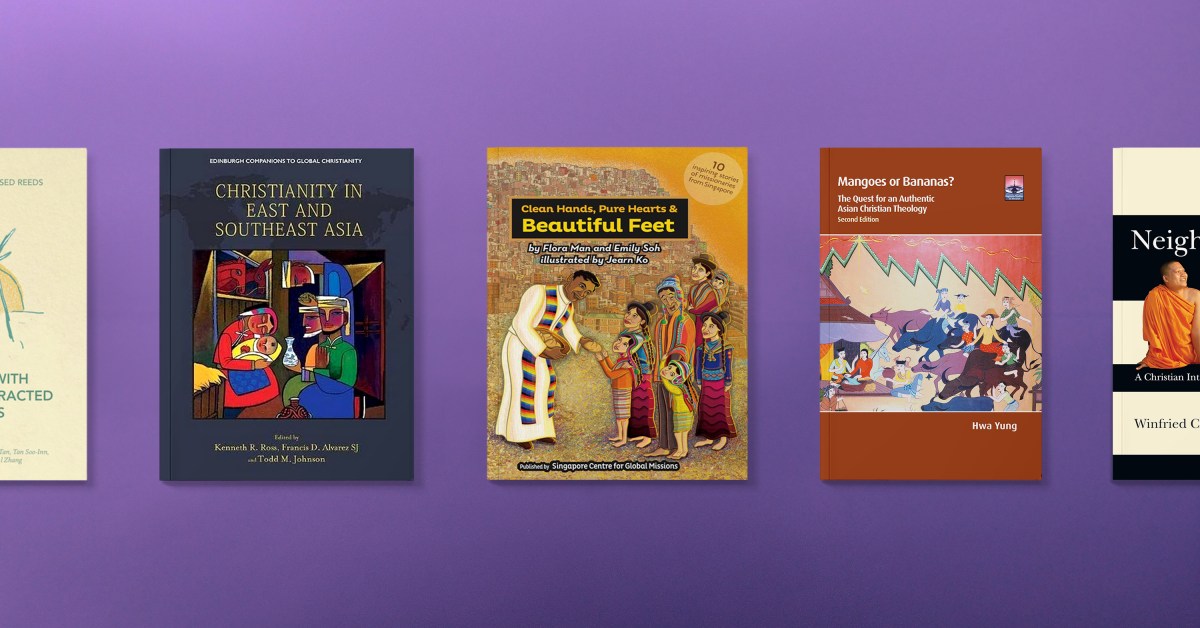
For a comprehensive understanding of Christianity in Southeast Asia, this 2022 publication is a must-read. It offers clear statistical data, analysis, and insightful writing on core religious issues affecting every country in Southeast and East Asia, even as “what is Asian and what is Christian are still being constructed and discovered,” Roman Catholic theologian Francis D. Alvarez writes in his opening essay.
The book gives special focus to Christian growth and decline in places like Laos, Brunei, Timor-Leste, and Vietnam. You will learn about the faith’s historical impact, emerging themes, and developing trends in each context, such as evidence of church growth in ground previously hard for the gospel in Thailand and Indonesia.
This is a helpful resource for church and mission leaders, researchers, or seminary students who are hoping to gain a deeper, broader grasp of how Christianity is shaping identity and culture in the region.
Believers in Southeast Asia are more like bananas than mangoes, Malaysian Methodist bishop Hwa Yung asserts. In other words, Christians only look Asian on the outside but have been schooled and discipled internally to think and behave like Western (or white) Christians.
Yung argues that Asian Protestant theologies continue to be held captive by Western Cartesian dualism—the idea that our rational minds and souls are independent from our material bodies—and enlightenment epistemologies that privilege natural or scientific worldviews.
These influences have diminished valuable aspects of Asian Christian identity, such as communal, holistic approaches to life and familiarity with the supernatural. Yung champions the need for more authentic contextualization within local worldviews while holding tenaciously to core and historic Christian tenets.
This scholarly work is Yung’s best known. I recommend it to Christians who want to explore critically how we should think, work, and live out God’s mission in the complex cultural milieus of Southeast Asia.
Southeast Asian Christians serve in varied and challenging places across the globe today. Countries that were once mission fields are now a mission force to be reckoned with, and this beautifully illustrated book is ample proof of that.
Stories of 10 Singaporean missionaries are brought to life in short, powerful detail for both children and adults. Many of these missionaries served in remote, far-flung places like the mountains of Bolivia, the villages of southern China, and the thick jungles of Papua New Guinea.
You’ll encounter people like Daniel and Wei Lei Jesudason, a couple who translated Scripture for two tribal groups steeped in sorcery and black magic in Papua New Guinea, as well as Tan Lai Yong, who raised up “barefoot doctors” in the hills of Yunnan Province, China.
Corduan writes as an evangelical committed to the exclusivity of the gospel while still managing to give each religion surveyed a fair and respectful analysis. His 449-page book is essential for believers in Southeast Asia who strive to love religiously diverse neighbors well.
Through a sociological perspective, Corduan explores various faiths—including Islam, Buddhism, Hinduism, and Sikhism— that are either the majority religion in a Southeast Asian country or strongly represented in the region. Each chapter provides historical, doctrinal, and practical details behind each religion and its contemporary practice today, with detailed descriptions of daily rituals and rites of passage.
Corduan also tackles topics like the rise of radical movements within Islam and discusses various popular Hindu and Buddhist movements that have exported their unique emphases and practices across Southeast Asia. He also provides suggestions for how Christians should engage each religion constructively and wisely.
Same-sex attraction is a thorny, often-taboo issue among the generally conservative churches of Southeast Asia. But it will not go away, and we must engage with it wisely and biblically.
This year, Thailand became the first Southeast Asian nation to legalize same-sex marriage. In other countries, notably the Philippines and Singapore, there are growing movements that support LGBTQ rights for marriage and are calling for “transgender” to be recognized as a legitimate gender category.
How should Christians approach this issue with truth and grace? This book features compelling first-person narratives of believers who have struggled or continue to live with same-sex attraction. It also offers insights into how churches can care well for them with compassion while maintaining fidelity to God’s original design and his redeeming grace and vision for all people.
Hannah Keziah Agustin
Compiled by Isabel Ong
Angela Lu Fulton in Hanoi
Erin Foley
Isabel Ong
View All
Jayson Casper
One Catholic and one Muslim, they disagree on the role of religion in their work in Lebanon, but are united in their aim.
News
Joyce Wu
The territory’s worst fire in decades claimed more than 150 lives.
The Russell Moore Show
N.T. Wright takes a listener’s question about the parable of the talents told in Luke 19, and why it’s not all that it seems.
Surinder Kaur
Amid rising persecution, Indian Christians share Jesus’ love with friends and neighbors through delectable dishes.
Compiled by Manik Corea
Explore how the faith has flourished in Singapore, the Philippines, Indonesia, and other countries in this religiously diverse region.
Review
Grace Hamman
Classicist Nadya Williams argues for believers reading the Greco-Roman classics.
Ashley Hales
Some young Christians embrace lower-tech options.
Marvin Olasky
20 more suggestions from our editor in chief.
You can help Christianity Today uplift what is good, overcome what is evil, and heal what is broken by elevating the stories and ideas of the kingdom of God.
© 2025 Christianity Today – a 501(c)(3) nonprofit organization
“Christianity Today” and “CT” are the registered trademarks of Christianity Today International. All rights reserved.
Seek the Kingdom.