
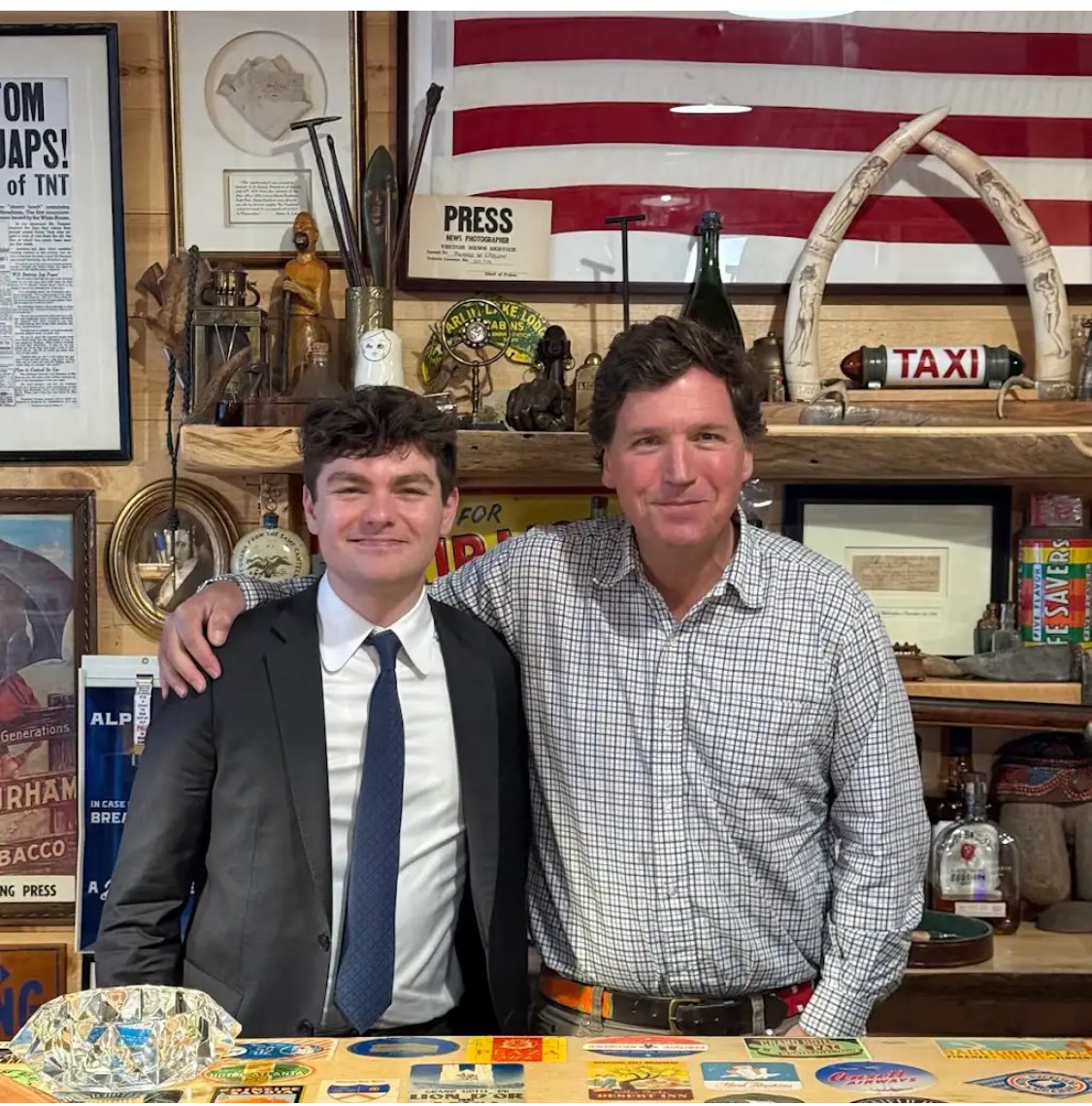
Tucker Carlson’s platforming of antisemitic social influencer Nick Fuentes, who proclaims “Christ is King,” evinces the reemergence of antisemitism in American Christianity. For the last 85 years, World War II and the Holocaust have made antisemitism publicly unacceptable in American Christianity, prior to which it was often acceptable.
For example, at the 1924 Methodist governing General Conference, the church’s prominent Prohibition chief, Clarence True Wilson, blamed the “filth” of films and theater on Jewish “degenerates, all of one race but of no religion, who have corrupted everything their filthy hands have touched for 2,000 years.” He warned: “No nation that has let them control its finances but has had to vomit them up, sometimes with bitter persecutions, to get the poison out of their system.” Wilson faulted German Jews for their “controlling interest in our liquor traffic.”
The audience for Wilson’s remarks included hundreds of Methodist leaders plus the church’s bishops. Yet there’s no record that his speech was controversial. Wilson continued as head of the denomination’s Washington, DC office on Capitol Hill for another eleven years. Methodism was then America’s biggest Protestant denomination. And its political influence was such that it was the main force responsible for persuading America to adopt Prohibition, with Wilson its chief advocate. So his anti-Jewish speech did not come from a marginal figure and likely represented the views of millions of Protestants, many of whom joined in the 1920s Ku Klux Klan resurgence, which made Jews with Catholics and blacks its chief targets.
American Christianity, and America, have been blessed that antisemitism across 85 years has mostly been taboo. But the memories of World War II and the Holocaust are fast fading. And revisionism about both, promoted by Carlson and Fuentes, among many others, is increasingly common. Human nature being what it is, demons once expelled often return and must again be exorcised.
Compounding the fading of historical memory, but not unrelated, is the emergence of post liberalism in American Christianity, and in wider intellectual life. The consensus about liberal democracy in which everyone has equality in law, with freedom of speech and freedom of religion, is retreating. Provocative commentators, once edgy but now increasingly mainstream, deride American’s founding traditions as passe or built on false premises from the start. Insisting on traditional American principles about equality for all is now commonly deemed archaic, “woke” or squishy. These bracing critics urge that society disavow these unnatural abstractions in favor of the “strong gods” that include religion and tribe.
Among these Christian post-liberals are Catholic integralists and Protestant confessional state advocates, who sometimes self-identify as “Christian nationalist,” who insist, as liberalism and religious freedom crumble from the weight of their own contradictions, an official Christian state must emerge. By definition, non-Christians, like Jews, would be less than fully equal in this imagined postliberal society.
Most of these postliberal Christian commentators would reject the zealotry and extremism of Fuentes. Some are friendlier to Carlson. Other postliberal Christians are friendly to Fuentes. Maybe some of them are only theatrically attention-getting, while others are more sincere. But even theatrically playing with antisemitism is dangerous and opens doors that should remain firmly shut.
Compounding this openness to antisemitism is the decline of American evangelical philosemitism often tied to Dispensationalist Christian Zionism. Neither philosemitism nor Christian Zionism depends on Dispensationalism, with its theories about the End Times. But Dispensationalism, whose influence perhaps peaked in the 1980s or 1990s, was a chief pillar for evangelical warmth towards Jews and Israel. As it fades, there are no clear successor pillars. And by definition, social polarization and increased tribalism are often unfriendly to minority “tribes,” likes Jews. The decline of universal values leaves every tribe to fend for itself, with the smallest tribes, unless protected by larger tribes, left vulnerable.
Further adding to the openly unfriendly stances towards Jews is the crumbling of institutional Christianity, with its transgenerational teachings and gatekeepers. American Christianity is now individualized and online. It no longer necessarily entails church participation. And while a local pastor may seem dull and phlegmatic, online zealots like Fuentes can seem boldly electrifying. The local pastor might be accountable to a denomination or at least a congregation. Online “Christian” firebrands are accountable to nobody except their online fans, whose stimulation demands constant outrage. These online “preachers” don’t demand repentance or self-denial, just rage against enemies, which is easier and more appealing.
Of course, the collapse of Christian institutions and organized authorities, amid polarization and tribalism, and rejection of universal values, feeds conspiracy theories. What is ostensibly real is actually fabricated by discredited authorities, it is alleged. The real “facts” of the matter are exposed by online zealots who are not “afraid” to tell the “truth” about how innocent followers have been manipulated by devious elites.
Across centuries Jews naturally are the historically favorite target of conspiracy theories. They are few in number, the conspiracists allege, but powerful and controlling through their cunning. They are so devious that they can deceive and manipulate whole nations. It’s no accident that postliberal zealots often obsess over World War II revisionism. Churchill and Roosevelt were the real villains. Hitler did not want war. The Holocaust was not as bad as portrayed, etc.
The postliberal perspective that dabbles in if not fully embracing antisemitism often claims to be Christian. “Christ is King!” The enemies of Christ must be defeated. Christ’s reign must be enacted by the bold and the strong who will not weakly extend mercy to Christ’s ostensible foes.
Christianity’s traditional stress on mercy, compassion, forgiveness, self-denial, and love of enemy does not factor large in the Christian postliberal equation. Their preference for power, control, and vengeance, with obsessive disdain for minority groups like Jews, embodies what Christianity has typically warned against: the world, the flesh and the devil.
So, there’s nothing new about the upsurge in antisemitism among Christians and in society. It’s a very old evil, parcel to fallen humanity’s proclivity to fault others for the world’s ailments, when all of us as sinners are contributors. The lessons about antisemitism learned from the Holocaust will have to be relearned. Humanity has short memories. Affirming the dignity of all, intrinsic to Christianity, is not natural. It must be continuously retaught and incarnated.
Antisemitism, in subtle and blatant forms, likely will grow in American Christianity. Discerning American Christians must prepare to counter it. The argument against it is not complex and comes directly from our Savior: Love thy neighbor as thyself, without exceptions.
No comments yet
Your email address will not be published.
Related Reads
1
2
3
4
The work of IRD is made possible by your generous contributions.
Receive expert analysis in your inbox.
Institute on Religion and Democracy
1023 15th Street NW, Suite 200
Washington, DC 20005
Contact us | Media requests
© 2025 The Institute on Religion and Democracy. All rights reserved.
Dear Reader,
Will you stand with IRD and faithfully support the church coverage you rely on today with a special gift of $100, $250, $500 or whatever you are called to give?
Make your tax-deductible gift today!