
ted.adventist.org/news is a website of the Seventh-day Adventist church in the TED Region.
Seventh-day Adventists are devoted to helping people understand the Bible to find freedom, healing, and hope in Jesus.
Adventist.org ADRA Adventist World Radio Hope Channel
Exploring faith-driven impact with JD Bauman
23 November | London, UK [Vanesa Pizzuto]
I was mindlessly scrolling on Instagram when an ad cut through the blur of reels: “Christians for Impact.” The name stopped me. “What is that?” I wondered, and I clicked. The conference, held at Mary Ward House in London on 22–23 November, promised to help attendees maximise their impact on some of the world’s most pressing problems: health, extreme poverty, and catastrophic risks. “Ok, I am game,” I thought, and I bought tickets after convincing a friend to come with me.
When we arrived on that rainy Saturday morning at Mary Ward House (just a stone’s throw from Euston Station), I was still jetlagged from a conference in Bulgaria and entirely unsure what to expect. But seeing roughly 200 Christians, mostly in their 20s and 30s, clearly energised about making a difference in the world (and, if I am honest, the large selection of snacks) immediately put me at ease.
The talks covered a breadth of topics: from radical generosity (led by Grayden-Reece Smith, a businessman in a high-earning career who has donated over £250,000 to charities), to facing the challenges of AI (led by Will Jones from the Future of Life Institute), to protecting animals (led by Revd Darrell Hannah from Operation Noah). Each talk felt relevant and outward-looking, inviting Christians to confront the world’s unfolding crises with faith, courage, clear-eyed analysis, and loads of data. If I had to summarise the event with one word, it would be “inspiring.”
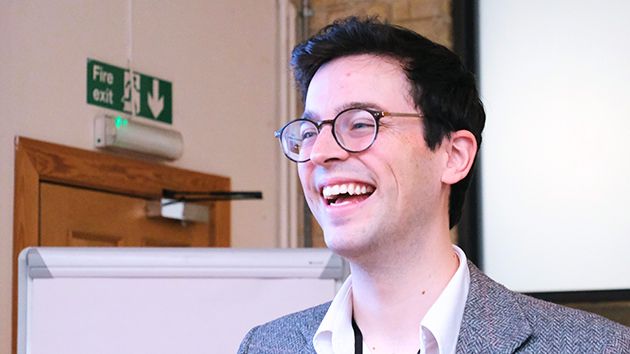
At the end of the conference, I approached JD Bauman, the Director and Founder of Christians for Impact, who agreed to a short interview on effective altruism and why it has a place at the heart of Christianity.
VP: Until recently, I didn’t really know what “effective altruism” meant. What’s your definition?
JDB: Effective altruism is two things. First, it’s the idea that we should use evidence and careful reasoning to find the most effective ways to love our neighbours, and to act on that basis. Second, it’s a global movement of organisations and individuals collaborating to identify the most impactful charities, careers, and opportunities.
Effectiveness matters because not all efforts to “do good” are equal. Some charities save or transform far more lives per pound than others. Thanks to evaluators like GiveWell (who have spent over 100,000 hours reviewing the data), we now know some interventions are hundreds of times more effective than others. As Christians, we should care about that difference, because loving our neighbour includes stewarding our resources wisely.
What originally pulled you into this line of work? Was there a specific moment or story that sparked it?
When I was 19, working in financial sales in New York City, I learned that for roughly $3,000, I could save a child’s life from malaria through the Against Malaria Foundation (a charity with strong evidence behind it). When I did the math, I realised I could save a busload of children each year.
That image shook me. If we saw a bus of kids heading off a cliff, we’d do almost anything to stop it. Jesus certainly would. It made me reconsider every unnecessary purchase: every $3,000 spent on myself could have been a life saved.
When I shared this with peers, the response was often denial, deflection, or excuses, especially from Christians, which surprised me. That disconnect strengthened my resolve to help believers embrace more impactful generosity and more purposeful careers.
This ultimately led to the founding of Christians for Impact, where we help Christians discern high-impact careers, give more effectively, and engage with pressing global needs, from extreme poverty to animal suffering, with both compassion and wisdom.
I recently attended the Christians for Impact conference in London. If you had to give an elevator pitch for next year’s event, what would you say?
The world faces massive challenges (extreme poverty, factory farming, spiritual darkness), and many Christians feel unsure where to start. But because of Jesus’ death and resurrection, we face these challenges with confidence and hope.
The Christians for Impact Conference equips believers to use their careers, influence, and money to make the greatest possible difference for God’s Kingdom. We ground everything in Scripture and prayer, and we pair that with rigorous evidence and research. You’ll walk away with clarity, confidence, and a plan for impact.
What’s your big, hairy, audacious dream for Effective Altruism for Christians (EA) over the next five years?
To see a generation of ambitious Christians intentionally tackling the world’s most urgent problems (poverty, suffering, injustice) using both faith and reason. Practically, that means expanding our conferences, advising thousands more people, and growing the EA movement so that impactful service becomes a normal part of discipleship.
A lot of people feel overwhelmed by global problems. What’s one small, practical step you think anyone can take to start “doing good, better”?
Most middle-class Christians can live well on 90% of their income. Giving the other 10% to the most effective charities is one of the simplest, highest-impact commitments you can make. Taking the 10% Pledge and directing it to top global health charities—like AMF or Helen Keller International—could save a busload of lives over a lifetime.
If giving isn’t your first step, then choose one or two global problem areas to dedicate your career and influence to. This focus creates intentionality, and intentionality leads to impact.
EA often sits at the intersection of data, ethics, and empathy. How do you personally balance the numbers with the human stories behind them?
There’s a saying that “the death of one is a tragedy; the death of a million is a statistic.” But that’s not how God sees it. A million deaths are a million tragedies: each person made in the imago Dei, each known and loved by Him. I try to keep God’s perspective front and centre, especially when the people (or animals) I’m helping are far away or invisible to me. The numbers guide my stewardship; the Holy Spirit and regular prayer guide my heart.
What’s a misconception about EA that you keep running into, and what do you wish more people understood?
Many assume EA is just secular utilitarianism. It isn’t. As Christians, we can fully affirm effective altruism while honouring our Scriptural duties to family (1 Tim 5:8). God will ask us to give account for how we stewarded our talents (Matt 25), including how we served distant neighbours. But that never excuses unkindness, dishonesty, or neglect of the people right in front of us. EA is a tool to better love and serve others. It’s not an excuse to be a bad Christian.
[Photos: courtesy of Christians for Impact]
Exploring faith-driven impact with JD Bauman
The commitments followed months and, in one case, years of prayer, Bible study and supportive relationships
Executive Committee members chart a strategic course for mission, elect new leaders, and explore innovative opportunities for discipleship and digital ministry
ted.adventist.org/news is the official news website of the General Conference of Seventh-day Adventists, Trans-European Division.
© 2025 Trans-European Division of Seventh-day Adventists