
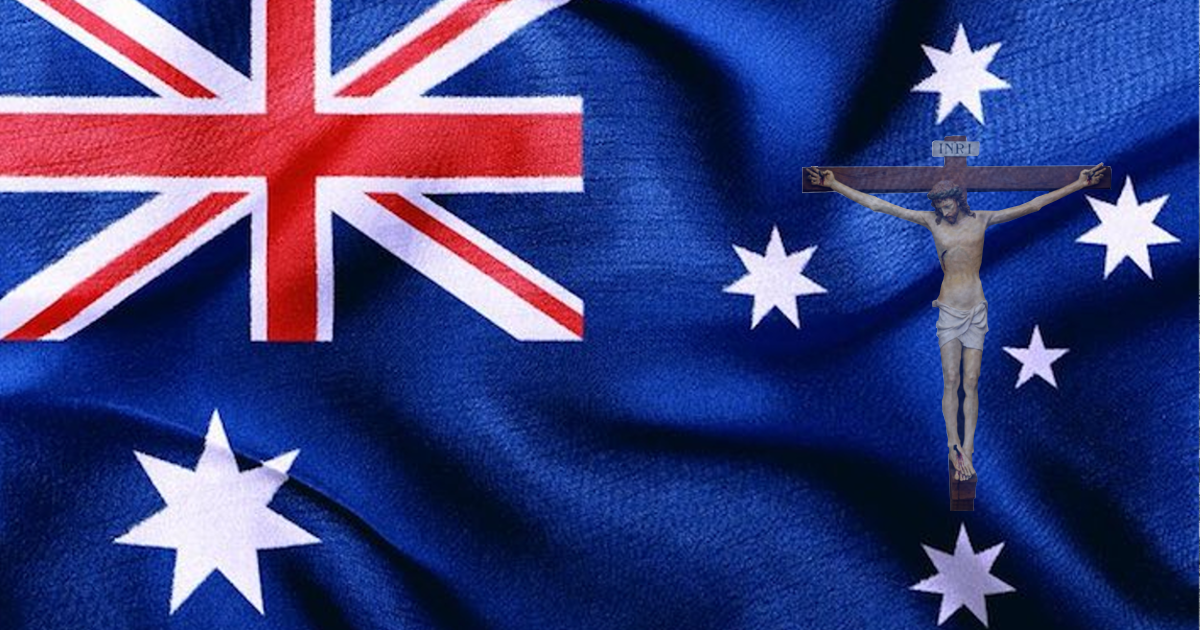

Australia celebrates its flag, on which no fewer than two Christian crosses shine. A warning to those who would like to uproot Christian symbols from the public sphere: they are one with the national identity.
A few days ago in Australia National Flag Day was celebrated.
Every September 3 marks the day when, in 1901, the Australian national flag was hoisted for the first time.
It can hardly be a holiday much loved by the country’s secularists, since the Australian flag preserves deep Christian roots.
The first reference is evident in the Union Jack, that is, the reference to the flag of the United Kingdom which represents the union of the crosses of the patron saints of England by interweaving the crosses of St George, St Andrew and St Patrick.
An emblem that is not simply a sign of British domination, but carries with it a historical and religious memory that helped forge the identity of which Australia is proud.
Alongside the Union Jack, completing the picture is the Southern Cross.
It is a constellation that has guided travelers and sailors of the Southern Hemisphere for millennia, but in Australia’s symbolic choice the arrangement of the stars visually evokes the image of a cross, to the point of making it evident how the Christian symbol appears twice on the same banner.
Martin Bush, a researcher at the School of Historical and Philosophical Studies, explained that the Southern Cross for European navigators was a clear Christian symbol, that is, “the idea that it was the cross of Christ placed in the Southern Hemisphere.”
For this reason as well the British writer Francis Nigel Lee said: “It is hard to imagine the flag of any other country with a more explicit Christian meaning.”
Australia is not alone in this.
Let us return to our dossier on flags around the world, in which we show the incredible spread of Christian crosses on the banners of countries worldwide, demonstrating how much Christianity has influenced the formation of states and nations.
No other religion can boast such a wide diffusion.
Dozens of cases in which the cross has been adopted as an identity and civic symbol, beyond the confessional sign. Exactly what happened in Australia.
In the face of this evidence, one is reminded of the ever-lively controversy over the removal of crucifixes from school classrooms.
A paradoxical initiative. Those who claim the (alleged) neutrality of public and school spaces forget that the cross is already imprinted, in a much more visible way, on national flags, institutional coats of arms and even civic logos.
If one truly wanted to eliminate every Christian trace, one would have to start with the flags themselves, and thus with one of the highest symbols of a nation’s political and civic life. But at that point, one would have to reckon with the cultural roots that have shaped entire peoples.
Help us to support the reasons of faith
© UCCR Online