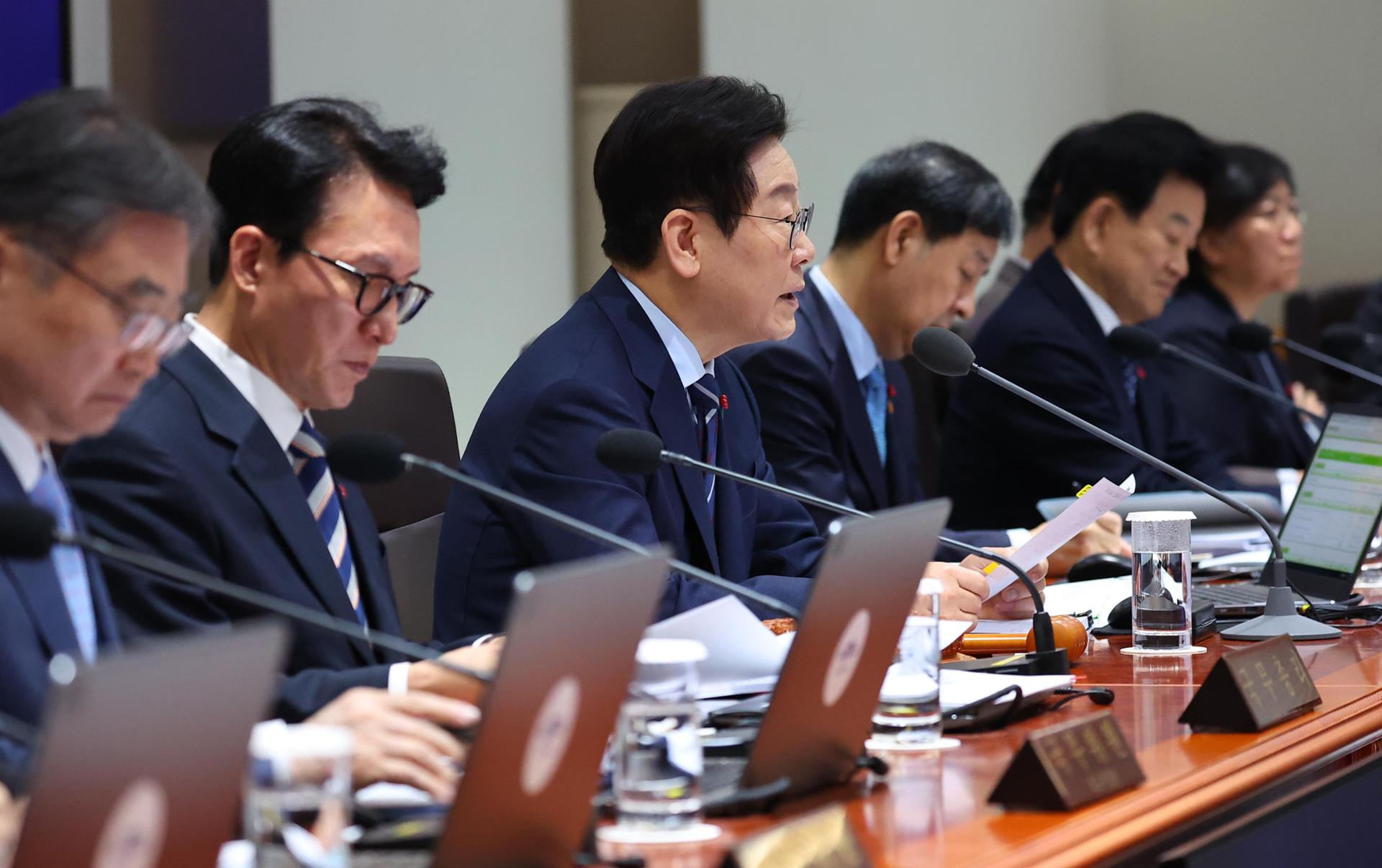
President Lee Jae Myung, third from left, presides over a Cabinet meeting at the presidential office in Seoul on Dec. 2, 2025. Yonhap
As Korea and its public look back on the past year following the botched Dec. 3 martial law declaration, President Lee Jae Myung has made various comments covering the attempted insurrection, the strength of Korea's democracy and the way forward. During Tuesday's Cabinet meeting, the president — among others — brought up the separation of politics and religion, noting that a religious group was violating this principle.
"The principle of separation of politics and religion is extremely important, but recently there has been a case where a religious group has systematically intervened in politics," Lee was quoted as saying. He did not specify the name of the entity, but it's not difficult to guess that it was in reference to the Unification Church. While directing the justice minister to look into ways to tackle this kind of political intervention, Lee mentioned a precedent set by Japan, noting that it "has ordered the disbandment of a religious group that intervened in politics."
Lee was citing the case of the Tokyo District Court's order in March for the dissolution of the Unification Church in Japan. The court order followed in the wake of former Prime Minister Shinzo Abe's assassination in 2022, as subsequent investigations revealed decades of political funding from the church that went to the governing Liberal Democratic Party. For instance, four Cabinet members from Fumio Kishida's administration (2021-24) were found to have received political funds from the entity. The Unification Church has appealed, and the appeals trial is underway.
The ongoing trials and special counsel probe centering around former President Yoon Suk Yeol's charges of insurrection, former first lady Kim Keon Hee's corruption charges and the death of a marine have shown that the Unification Church in Korea moved to curry favor with the Yoon administration after he became president in 2022.
Rep. Kweon Seong-dong of the opposition People Power Party (PPP) is also on trial for allegations of receiving bribes from a Unification Church senior official seeking to use his close ties to the former president. The accusation is that the church sought favors from the first couple. Han Hak-ja, leader of the Unification Church, is likewise under trial for allegedly delivering an expensive necklace and Chanel handbags to the former first lady. Both Kweon and Han are detained as they undergo their respective hearings.
The attempt to "buy" political favor is unlawful and should rightly be shut down. In a democracy, people are ensured a voice for their opinions by exercising their right to vote. An attempt to buy more political influence through funds or gifts risks sidelining or underrepresenting other groups. In the process, it intrudes on others' freedom.
At the same time, people have the right to freedom of religion, and the Unification Church, despite its controversies, has its followers.
People also have freedom of expression. However, it must be exercised with prudence by those in the public realm. The ruling Democratic Party of Korea (DPK) leader Jung Chung-rae has floated the idea of a law that could allow legislation to dissolve political parties — in their case, the opposition PPP. With their majority in the National Assembly, the DPK's words could be seen as political targeting.
However, when the president in a Cabinet meeting mentions the possibility of dissolution of a religious group that intervenes politically, his words may well carry the weight of his office. At the very least, this move could limit individuals' freedom of expression; at most, it stirs fears of religious persecution. When Lee stresses the importance of the separation of politics and religion, he must ensure that the political arena, in return, does not overtly intrude into the religious realm. Most of all, the freedoms enshrined in our democratic Constitution must be upheld.