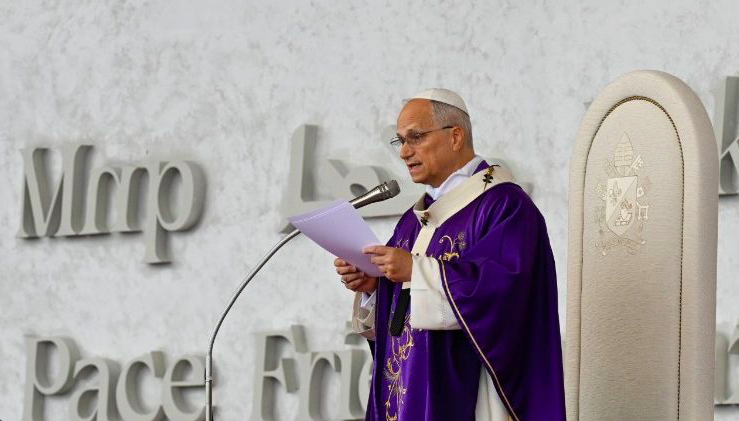
Christian broadcasters have said that Pope Leo XIV’s visit to the Middle East represents a moment of hope for the region’s struggling Christian communities.
The Pope’s six-day visit began in Turkey on 27 November and included a pilgrimage to Nicaea – modern-day İznik, to mark the 1,700th anniversary of the Council of Nicaea at which the Nicene Creed was formulated.
On 30 November the Pope flew to Lebanon, where he met political and religious leaders and prayed at the Port of Beirut, the scene of a devastating explosion in 2020.
Travelling with the Pope were staff from Christian broadcaster SAT-7.
Rita El-Mounayer, CEO of SAT-7, welcomed the Pope’s visit, saying, “One of our missions as a Christian broadcaster in the Middle East is to highlight and celebrate the region’s rich Christian heritage.”
Much of early Christian history was centred around what is considered the modern Muslim world. Paul was converted on the road to Damascus in Syria, the seven churches in Revelation were all located in modern-day Turkey, and key centres of Christianity like Alexandria and Antioch are in Muslim-majority countries.
El-Mounayer added, “The Pope’s visit to Türkiye and Lebanon is hugely significant for Middle Eastern Christians at this time. And it is not only Christians who need this: the whole region is longing for a message of hope, peace and encouragement.”
Despite the ancient links the Middle East has with Christianity, the Christian population in the region has collapsed.
Christians account for just 0.2 per cent of Turkey’s population, while across the Middle East the Christian population has dropped from about 20 per cent a century ago to just four per cent.
This sharp decline has been driven largely by the endless wars and conflicts in the region, beginning with Turkey’s genocide of the Armenian Christians and running through various Arab/Israeli conflicts, the US invasion of Iraq, and the rise of ISIS and the Syrian civil war.
In a heartfelt message to “Christians of the Levant”, the Pope repeated his appeals for peace and called on Christians to be peacemakers.
“The path of mutual hostility and destruction in the horror of war has been traveled too long, with the deplorable results that are before everyone’s eyes,” he said during Mass at the Beirut Waterfront.
“We need to change course; we need to educate our hearts for peace.”
He concluded with words of encouragement as he called on Christians in the region to face difficulties with courage.
“Finally, to you, Christians of the Levant, citizens of these lands in every respect, I repeat: have courage!” he said. “The whole Church looks to you with affection and admiration.”
El-Mounayer expressed hope that the papal visit would provide hope to the regions remaining Christians.
“The last few years in Lebanon have been extremely distressing and traumatic,” he said.
“As a Christian broadcaster, we always seek to share a message of hope and peace with our viewers, but this has been incredibly challenging in the face of war, tragedy and loss.”
Maroun Bou Rached, Executive Director of SAT-7 also welcomed the visit: “The Pope’s visit to Lebanon is a major lift for people here—especially Christians.
“For me personally, having the chance to cover such a positive and hope-filled occasion after so much pain is a huge encouragement.”
What is Advent Sunday and why do churches mark it?
Correspondence from Alice in Wonderland author, Lewis Carroll, discovered in Lincoln Cathedral
Shine Jesus Shine tops poll of favourite assembly hymns
The history of the Advent calendar
What is Advent Sunday and why do churches mark it?
Who was St Andrew and why is he important?
Televangelist Benny Hinn and wife, Suzanne, finalize divorce for a second time
Conor McGregor describes profound encounter with God during trauma therapy
Nigerian president declares nationwide security emergency after repeated attacks on Christians
National Trust asked to reconsider after filmmaker denied permission to film at Christian site
Real life is very rarely about the “goodies” and the “baddies”.
Following US aid cuts, African governments may need to take responsibility for their own people.
The Pope appealed for peace before departing Lebanon at the end of his first foreign papal trip.
Two churches in Port Sudan were defaced in coordinated acts of vandalism, with Islamic declarations painted in red graffiti on their exterior walls. The incidents occurred last week in the center of the city’s market area.
Papal visit to Middle East an encouragement to the region's remaining Christians – www.christiantoday.com

ByEric Djirackor
Dec 3, 2025