
Homeless Hilal on track for CAF Champions League last eight
Bangladesh court jails British MP Tulip Siddiq in absentia
Take Off İstanbul: Countdown to entrepreneurship summit begins
Has the Israeli state lost control of the settler movement?
How Gaza is entering an uncharted era of foreign guardianship
Testing the waters: Is Saudi Arabia re-engaging with Lebanon?
How Israel emerged as major threat to Syria's post-Assad future
As MAGA turns on Zionism, Israel First right stokes Islamophobia
Graphic Truth
Israel’s International Border Eraser
After the ceasefire, Gaza faces an unending war with trauma
How Yalla! Let's Talk became the Arab diaspora's leading podcast
Inside Amir: A quiet portrait of leaving Iran
Scrap wars: How child labour and conflict feed Turkey steel boom
TNA report prompts Egypt to ban New Valley tourist bird hunting
French think tank Sahel Intelligence exposed as Moroccan disinfo
Breadcrumb
With Pope Leo XIV’s three-day visit to Lebanon, Palestinian Christians, residing in Gaza and the occupied West Bank, found a rare glimmer of hope amid years of war, siege, and demographic decline.
On his flight from Turkey to Lebanon on Sunday, the Pope declared that a two-state solution is “the only option” to end the Israeli-Palestinian conflict, while acknowledging that Israel “does not yet accept it.”
For Palestinian Christians, whose numbers have dwindled over decades of conflict, the statement resonated deeply. Despite their small size, they see themselves as an inseparable part of the national fabric.
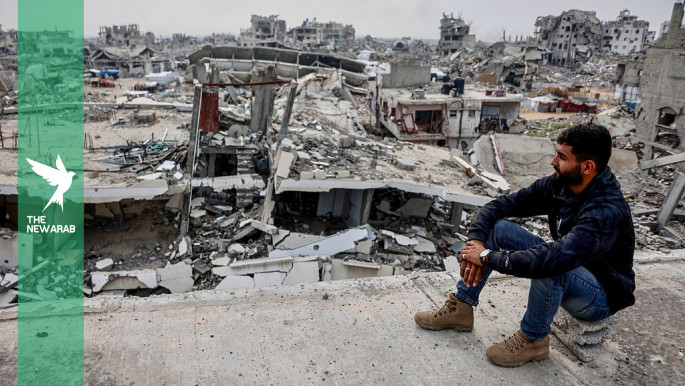
In Gaza, where Israel’s genocide and destruction are most visible, Christians struggle to survive amid ruins. Meanwhile, in the occupied West Bank, the challenges are subtler but no less suffocating: the wall, checkpoints, settlements, and the constant fear that their communities will disappear.
In the heart of Gaza’s Old City, among the rubble-strewn streets of the Qaysariya market, 78-year-old Riyad Shaheen sits outside the remnants of his family’s gold shop.
Only the wooden facade and a few burnt drawers survive. “I sit here so I don’t lose touch with life,” he told The New Arab.
For Shaheen, Pope Leo’s recent words deeply impacted. “This is a call for peace, a voice for Christians worldwide, and especially for Gaza,” he said. “We are part of the Palestinian people. The war spared no one. Christians here lost homes, relatives, just like everyone else.”
Shaheen recalled the early days of the war, when his family, along with dozens of Christian and Muslim families, sought refuge in the Church of Porphyrius. On 19 October 2023, a missile struck the church, killing 17 people and destroying part of the building.
“No one is safe in Gaza,” Shaheen remarked.
“When the Pope speaks of a Palestinian state, he gives us moral legitimacy before the world. Perhaps this will bring attention back to our suffering, the suffering of those who stayed and did not flee,” Shaheen added.
He hopes the Pope’s message could revive stalled negotiations and help Palestinians secure self-determination.
“The only obstacle is Israel’s refusal. Without recognition, nothing changes,” he concluded.
Nearby, 37-year-old Milad Ayad repairs antique watches in a small workshop. “The Pope’s words bring cautious hope,” he told TNA. “We’ve heard promises for decades, but change is rare. A statement from the Pope carries weight. The world listens.”
He noted that Christians in Gaza, a community that numbered no more than 1,100 before the war, have endured the same hardships as Muslims.
“Since the Nakba in 1948, Christians have faced persecution. The 2007 blockade accelerated our decline. Now, after recent airstrikes, we are fewer than 800,” Ayad said.
His most incredible frustration is not being able to visit Bethlehem, despite living geographically closer than most Christians worldwide.
“We inhabit the land where Christ was born, but we cannot pray there. The occupation prevents us. I hope we can go with my family this Christmas. Perhaps it will be different,” he explained.
In Bethlehem, religious tourism and survival coexist under Israeli military restrictions. Here, George Khoury, 46, runs his family’s carpentry workshop, producing olive-wood religious artefacts.
“Bethlehem lives in constant anxiety […] We cling to the spirit of Christmas, but the wall and checkpoints strangle us. The Pope’s call is not just political, it is essential for our survival here,” he told TNA.
Tourism, the city’s lifeline, has sharply declined. “I craft crosses shipped worldwide, yet I cannot move freely in my own city,” he said. “The Pope’s words are important, but without international pressure, they are not enough.”
Mariam Awad, 32, a music teacher and youth centre volunteer, frames the Pope’s message through her daily work with children.
“Peace is not an abstract idea for us. It is a necessity,” she told TNA, recalling her brother, who was killed two years ago at an Israeli checkpoint.
Her students cross checkpoints daily to attend school. “I see fear in their eyes,” she said, “and through music, I try to bring them some reassurance. Our community is small and under threat. The Pope’s call reminds the world that our presence here still matters.”
From Gaza’s rubble to Bethlehem’s checkpoints, Palestinian Christians agree: Pope Leo’s statement is more than symbolic. It is a reminder that Palestinians, of all faiths, still demand recognition and the right to live freely in their homeland.
Yet, the realities remain harsh. Gaza endures war and blockade; the occupied West Bank faces settlements and the wall. Palestinian Christians are dwindling, caught between survival and exile.
“For many, the Pope’s affirmation that a two-state solution is the only option restores some credibility to a Palestinian vision long ignored in international discourse,” Ahed Ferwana, a Gaza-based political analyst, told TNA.
“The weight of hope is heavy. But for those in Gaza and Bethlehem, the Pope’s words, though not a solution in themselves, may mark the start of renewed attention to their struggle, a fragile spark in a landscape dominated by conflict, walls, and fear,” Ferwana added.
Inside Pope Leo’s tour of Lebanon’s important Christian sites