
NewsMatch is underway! New gifts made through Dec. 31 are being MATCHED 2X — up to $5,000 per gift. Give today!
CT Mirror
Connecticut's Nonprofit Journalism. 
This work is licensed under a Creative Commons Attribution-NoDerivatives 4.0 International License.
by John Hall, CT Mirror
December 1, 2025
CT Mirror’s independent, nonprofit journalism depends on reader support.
Create more of it with a tax-deductible donation today.
Amid all the other strange and alarming things happening in our world, we also have the outcry of angry, defensive Christians —Protestant fundamentalists in particular—proclaiming from pulpits and podcasts that secular liberals have destroyed traditional Christian values essential to our nation.
The values cited have mostly to do with gender roles and sexuality: women should submit to their husbands and embrace childbearing and childcare as their primary functions; gender identity variability is unbiblical and corrosive to morality; and a godless society is doomed to collapse.
These claims are not new; we have heard them coming from conservative Christians over the past 50 or even 150 years. What is new, and surprising, is that these same citizens have turned their religious zeal into devotion to a political demagogue, dismissing glaring moral flaws they once held to be disqualifying. The common ground between religious fundamentalism and our government’s authoritarian character is disdain and anger toward secular liberals, intellectual and economic elites who, so the argument goes, hate America and are the cause of our problems.
But what we have is not a reasonable, civil discourse on political science. It’s a deluge of bizarre disagreements or plain lies about simple facts, even when evidence supporting the facts is clear and compelling. Deeper still is a tangle of emotions arising from loss following rapid cultural and economic change: anger, alienation, fear of more loss, and changes in the status of racial and class groups. To unravel it all is beyond the scope of this essay, but some constructive light may be shed by reflecting on another period of cultural, religious, and intellectual change.
Our nation’s founders were generally cautious, if not downright skeptical, when it came to religious enthusiasm and divisive sectarian claims. Still fresh in the public memory were the demonization and torture of religious “heretics” and “witches” in the colonies.
CT Mirror stories are never behind a paywall. But we still rely on contributions from individuals to report stories like the one you’re reading right now. Help us do the work.
If you believe in a free press, can you start a $15/month recurring donation today?
New gifts are MATCHED 2X until December 31!
Before that were the senseless religious wars and chaos of 16th and 17th century Europe. The leaders of the constitutional convention were Deists —Enlightenment rationalists who conceived of God as the creator who set the cosmos in motion, then left it alone without subsequent intervention. This view relegated God to more of a supporting role on the stage of the human drama —a God that was providential but not in charge of the details. The authority of the Bible was starting to fray, as scholars struggled with its miraculous and mythological content.
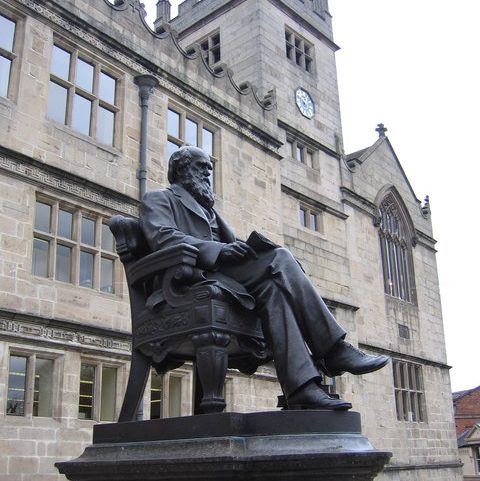
With the publication of Darwin’s On the Origin of Species in 1859, religion in the western world faced a more singular crisis. The book popularized hard evidence that God had not created all forms of life during seven days, but that life had evolved gradually over a much longer timespan. Many clergy and other opinion-makers accepted the new time scale, taking the position that God drove the process of evolution itself, though that suggested that God was something more abstract, not the human-like God who made Adam from the mud and Eve from a rib.
More conservative defenders of the faith opposed the fact of evolution bluntly, using theatrical slogans such as “man didn’t come from apes.” But after some decades, the scientific community and members of the public who took the time to understand the evidence for Darwin’s theory accepted evolution as a compelling explanation for the diversity of life and its ongoing changes. The wobbly legs of Biblical authority were now disturbingly visible.
Protestant fundamentalism was born in the late 19th century as a reaction to Darwin’s book and a bulwark against this erosion of Biblical authority and the related threat to Christians’ cultural status. Fundamentalist leaders proclaimed a strategic retreat, a refusal to engage in evidence-based debate about religious truth. The party line was simple: true believers should not be tempted by the rational conceits of a fallen and godless world, exemplified by university scholars, including Biblical scholars. The Bible was the inerrant Word of God, period.
Any so-called “evidence” that the earth was millions or billions of years old was not admissible in the court of God’s judgment. Even today, some congregations have an unspoken covenant to reject the theory of evolution as an attack on faith. Some Christians even reject the specific findings of geologists, proposing that God planted a deceptive fossil record in the layers of mountain rock to test our faith.
But there is another reason why evolution was and still is such a key concept when it comes to understanding fundamentalist religion. If life evolved as a succession of atoms, bigger atoms, molecules, self-replicating molecules, and up the evolutionary tree to intelligent animals, culture, and technology, then religions evolved too. That suggests that the Bible did not come straight from God fully formed, but rather evolved through a succession of beliefs, rituals, and earlier texts —like everything else in human culture, all of it going back to the primal soup. Of course, we have ample textual evidence that the Bible did evolve, but to concede that, for some, was to lose the game entirely.
Evolution is, for some religionists, an inconvenient fact because it legitimizes change and complicates the search for absolutes. Denying evolution, on the other hand, serves as a balm for those most hurt by rapid social change and who long to reverse that change. Autocracies thrive when large segments of the population have experienced loss of community pride, economic viability, and status when compared to others who were luckier. For autocrats, facts simply get in the way of delegitimizing critics’ expertise and capitalizing on loss and anger to seduce segments of the population into believing that the situation is hopeless without the authoritarian’s exercise of power. In our present case, religious fundamentalists and the allies of autocracy find unity in opposing their stated common enemy: secular liberals.
But facts are not something we can afford to ignore. And the demonization of those who see the world differently is not a path to healing our society and solving problems in ways we can all live with.
Religion tempered by reason enriches people’s lives in many ways —providing space where people can belong, reminding us of our fallibilities, and helping us not to despair of our certain death. But religion, like any absorption in an ideological or utopian vision, involves some degree of magical thinking. It is not an appropriate tool when it comes to vaccine safety, just as ignoring the facts about tariffs and using them to exercise imagined grievance will not help us manage the economy.
We occupy a crowded planet, changing fast due to accelerating technology. Our challenges call for complex strategies anchored in the physical world to generate food and energy, avoid disease, keep the peace, and minimize the damage we do to the life around us. Depending on a God, a demagogue, or an ideology to save us from our own appetites and impulses is not a serious plan for self-government.
It’s up to all of us, hearing each other, understanding each other more deeply, and evaluating various policy prescriptions in search of solutions. That is the messy, difficult, and essential struggle of democracy.
John Hall lives in Portland.