
Druze Sheikh Raed al-Mutni 'dies in detention' in Suweida
US to hold talks with Putin on ending Ukraine war
Turkey says tanker sailing from Russia reports attack
Lebanon on the edge: A nation braces for Israel's next war
War from within: Israel's bid to exploit Iran's ethnic divisions
Has the Israeli state lost control of the settler movement?
In marriages across MENA, consent is fictional and rape is legal
How Israel emerged as major threat to Syria's post-Assad future
As MAGA turns on Zionism, Israel First right stokes Islamophobia
In a divided Lebanon, Christians find hope through Pope Leo
After the ceasefire, Gaza faces an unending war with trauma
How Yalla! Let's Talk became the Arab diaspora's leading podcast
Scrap wars: How child labour and conflict feed Turkey steel boom
TNA report prompts Egypt to ban New Valley tourist bird hunting
French think tank Sahel Intelligence exposed as Moroccan disinfo
Breadcrumb
“Blessed are the peacemakers,” read the billboards bearing Pope Leo’s portrait that have sprouted across Lebanon. The tiny Mediterranean country spared no pageantry ahead of the pontiff’s arrival.
The flags of Lebanon and the Holy See fluttered along hastily re-tarmacked roads. The message “Welcome Pope Leo” popped up on millions of people’s mobiles when one of the largest network providers changed its display name.
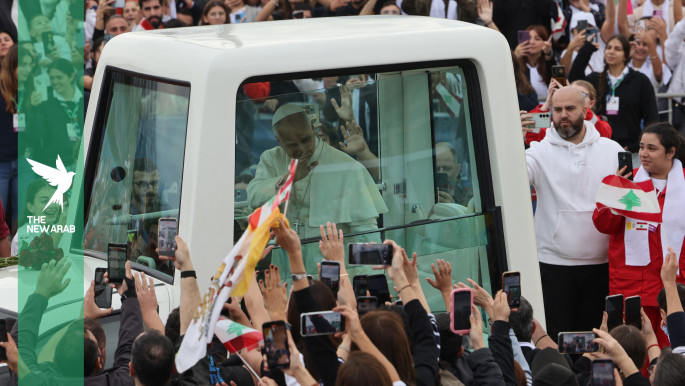
And as the Pope’s plane landed, Beirut was filled with the sound of church bells and foghorns from the city’s port. But as the bulletproof Popemobile set off from the airport, a Mediterranean downpour rained on the parade.
For many Lebanese Christians, Leo’s visit will feel like a Hail Mary. A last-ditch attempt, however unlikely, to secure peace and unity in a divided nation battered by war and threatened by the prospect of renewed conflict with Israel.
The Vatican will strive to reassure its followers in Lebanon, the country with the highest share of Christians in the Arab world, whose numbers have dwindled over recent decades due to instability and economic pressures.
“You are a people who do not give up, but in the face of trials, always know how to rise again with courage. Your resilience is an essential characteristic of authentic peacemakers,” Leo said in his first speech from the Presidential Palace in Baabda.
“A challenge,” he added, “is what can be done to ensure that young people in particular do not feel compelled to leave their homeland and emigrate?”
If the hope is that papal diplomacy might succeed in stabilising the region where traditional politics has failed, this has not been the case in the past.
Leo is not the first pontiff to try to bring peace to Lebanon. And he will find that much has befallen the country since the last papal visit by Benedict XVI in 2012. Financial collapse, an abortive revolution, Covid-19, the devastating Beirut port explosion, and a 13-month war with Israel have left the country reeling.
“Life here has always been hard,” said Mary Harb, 33, a schoolteacher and Maronite – the largest Catholic denomination.
“Sometimes it just sucks being Lebanese. There’s the constant threat of Israel. Every few years, there’s a war. But the Pope symbolises peace. It gives people hope that the future will be better.”
Leo will be the third Pope that Harb has seen visit her country. When John Paul II came in 1997, Lebanon was still recovering from 15 years of vicious civil war that ended in 1990.
The political landscape has rearranged itself since then. After its month-long war with Israel in 2006, Hezbollah was stronger than ever. However, the group lost much of its military capability and political clout after its latest war and the fall of the Assad regime in Syria, a longtime ally.
But with US pressure mounting on the Lebanese government to disarm Hezbollah – while Israeli airstrikes continue almost daily – many fear the country is teetering on the brink of renewed conflict, or that the sectarian fault lines of the civil war will crack open again.
In a sign of the divisions that still lurk beneath the surface, Harb, like many Christians in the region, is concerned by the rise of Islamist powers in Syria, as well as Hezbollah’s ongoing influence in her own country.
For non-Catholics, like Baptist Pastor Tony Skaff, the Pope’s visit still carries political, if not spiritual, importance.
“As Baptists, we don’t believe in the Pope. We’re famous for refusing the papacy completely,” Skaff said.
“We see it as a political visit to support our collapsing country and the Christian minority in general. We don’t mind someone gentle and a nice Christian who’s coming to visit the country to help all Christians, even to support the non-Christians.”
Christians in Lebanon are more united now than they were during Benedict’s visit. At the time, the two main Christian parties were sharply divided by domestic politics influenced by the Syrian civil war, with rival camps supporting, or virulently opposed to, the Assad regime.
“The Christians today are of a similar mindset. They’re fearful for their future. They may be divided along narrow political lines, but with respect to the community as a whole, they all feel vulnerable in Lebanon today. I don’t really see that the Pope’s visit is going to make a major difference to that,” Michael Young, a senior editor at the Carnegie Endowment’s Middle East Center in Beirut, told The New Arab.
However, Young believes the timing of Leo’s visit is important, coming a decade after the regional uprisings that led to a haemorrhaging of Christians from Syria and Iraq. The Vatican will therefore seek to convince the Catholic community to stay in the country by promoting a message of peace and religious coexistence.
“This is not the first time the Vatican has taken a position on the Maronites. But it’s the first visit after a series of momentous events that have had an impact on the Christian presence. It’s an effort to say there are still Catholic communities in Lebanon that deserve support,” he said.
In a symbolic display of unity, on Monday, the Pope gathered the heads of Lebanon’s diverse religious sects – 18 in total – in Martyrs’ Square, the old no-man’s-land of the civil war.
Though it may be temporary, the nation’s rival forces have at least united in their desire to see that the Pope is well hosted. In an unexpected turn of events, young boys from the Hezbollah-run Imam Mahdi Scouts gathered to welcome the Pope on Sunday. Hezbollah supporters held portraits of Pope Leo and their late secretary-general, Hassan Nasrallah.
In a statement issued shortly before Leo’s arrival, Hezbollah denounced Israel’s war on Gaza and the ongoing attacks on Lebanon, calling on the Pope to “reject the injustice inflicted on our homeland.”
However, in a tit-for-tat exchange, the country’s largest Christian party, the Lebanese Forces, released a statement to prevent any “inappropriate attempt to mislead the Holy See”. They added that Hezbollah had “usurped the rights, freedoms, and decision-making authority of the Lebanese people.”
Swathes of Lebanon, mainly in the southern region and the eastern Beqaa Valley, still lie in ruins. Several members of parliament urged Leo to visit the south to witness the “human tragedy” there.
A ceasefire nominally brought an end to the war last November, but since then, 127 civilians have been killed in Israeli attacks, according to the UN.
For Father Pierre El-Raii, it is enough that the Pope is coming to Lebanon. El-Raii’s church is in Qlayaa, a small village about a mile from the Israeli border. It is still relatively unscathed in a sea of destruction.
“We are still in the middle of a war, and we are still holding on to hope. But we have not left our land, and that’s all that matters,” El-Raii said.
He hopes that Leo’s visit will give his congregation the spiritual strength to remain in Lebanon. Above all, he hopes Leo will bring peace.
“War leads to war, and ruin leads to ruin. There is no other way than for peace to lead to peace.”
Alex Martin Astley is a freelance journalist based in Beirut, covering conflict, foreign policy, and social justice issues
Follow him on X: @AlexMAstley
Migrant Ethiopian women see no relief from Pope’s Lebanon visit